
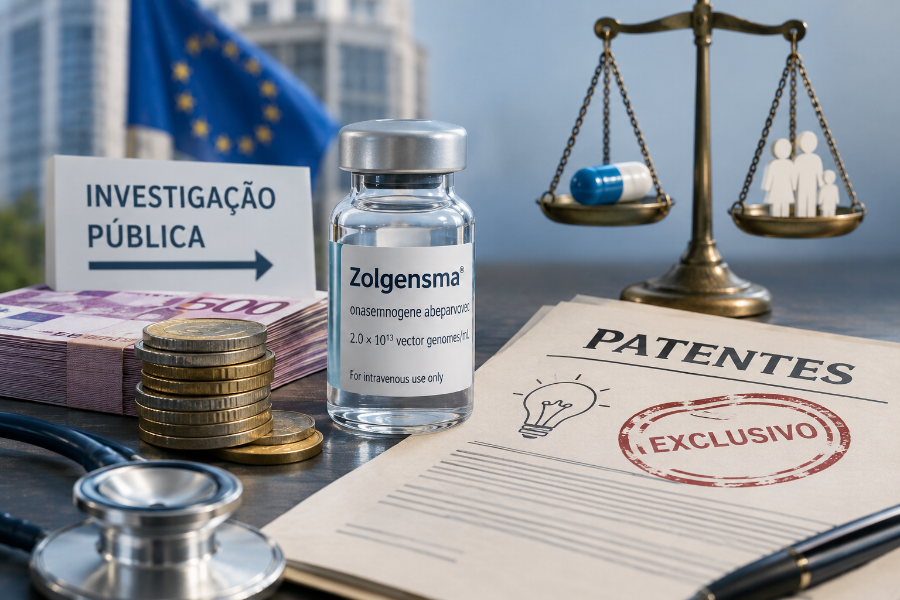

Brussels has concluded the reform of pharmaceutical legislation, but the case of the two-million-euro medicine administered at Santa Maria Hospital leaves a deeper question unanswered: who should own the intellectual property of medicines born of publicly funded research?
On Monday, the Council of the European Union adopted the new pharmaceutical package, which still has to go through the European Parliament. The reform aims to ensure equitable access to medicines at affordable prices and to prevent supply shortages. It does not, however, touch the underlying principle: whoever invents, patents and markets.
Whoever launches a new medicine will have eight years of exclusivity over pre-clinical and clinical trial data. Total protection, adding up the various layers, may not exceed eleven years, or twelve if the company uses the new transferable exclusivity voucher, created to encourage priority antibiotics. Two other points matter to patients: Member States will be able to require pharmaceutical companies to supply sufficient quantities of protected medicines, and generic manufacturers will be able to carry out studies and trials before the rights expire, so that they can reach the market on day one.
In Portugal, the price of a medicine acquired a human face with the case of the Luso-Brazilian twins treated at Santa Maria Hospital with Zolgensma, a gene therapy for spinal muscular atrophy, whose cost per patient was reported at around two million euros. The case now has a judicial dimension: the Public Prosecutor’s Office has brought charges against four defendants, who enjoy the presumption of innocence and whose liability it is not for this article to assess. Another question matters here: how can a single dose cost so much?
The first answer is comparison. Zolgensma is administered only once, and Novartis justified the price by measuring it against the cost of the alternative chronic treatment, Spinraza, which costs around 750,000 dollars in the first year and around 375,000 in each subsequent year — more than four million over ten years. By the company’s reckoning, the US launch price of 2.1 million dollars was half that cost, and Novartis itself went as far as saying the medicine would be worth between four and five million. Critics note that the benchmark is itself a very high price, so the comparison starts from an already inflated value.
The second is the market. Spinal muscular atrophy is a rare disease, with a few hundred new patients a year in the United States, according to Novartis, which means the investment has to be recouped from a very small patient population. And the investment was large: in 2018 Novartis bought AveXis, the company that developed the medicine, for 8.7 billion dollars. One industry analysis put its development cost at around 700 million dollars; critics cited by the Lown Institute argue that the research cost is no more than a few hundred million, recoverable within a few months of sales.
The third is the most uncomfortable: the price is what the payer is willing to pay. At the time of the launch, the president of ICER, the independent economic evaluation institute, observed that insurers would cover the drug whatever its price, and recalled that the company had admitted it could go as high as five million. ICER considered the final price to be at the upper end of the range it had calculated as justifiable. US senators, for their part, pointed out in 2019 that research funded by the National Institutes of Health had contributed to the drug’s development and that the company had benefited from accelerated regulatory designations and from a priority review voucher worth tens of millions of dollars.
In Portugal, the two million is the reference figure reported in the news. The president of Infarmed, the national medicines authority, stated in 2024 that the price actually agreed was substantially lower, without disclosing it for confidentiality reasons, and that payment was spread over four years, with an initial instalment and the remainder dependent on clinical results. In 2019, when the request was made, the medicine did not yet have a marketing authorisation, so a special use authorisation was used.
This is where the case becomes relevant to the debate on intellectual property. In a market like this, the price does not arise from production costs or competition, because there is no equivalent alternative: it arises from negotiation between a seller who holds exclusive rights and a buyer who cannot refuse to treat children. It is this asymmetry that advocates of public licensing say they want to correct. Critics reply that, for a therapy with few patients, complex manufacturing and high risk, a purely cost-based price would be hard to calculate, and that outcome-based payment contracts, such as the Portuguese one, show there is room for negotiation within the current system.
Instead of patents held by companies, the rights to molecules resulting from biomedical research would pass to a public body — national and, ideally, European. Industry would continue to manufacture and sell, but as a licensee: it would acquire licences per molecule and for a fixed term, with maximum prices set by contract and reversion of unexploited licences.
The underlying argument is that of double payment. A study of new-molecule medicines approved in the United States between 2010 and 2016 found that all of them had received direct or indirect funding from the US National Institutes of Health, which in some cases bore up to 80% of the R&D investment. If taxpayers fund the discovery, proponents argue, they should not pay again for the final product at a monopoly price.
Industry responds with cost and risk. Developing a medicine takes more than a decade, most candidates fail and the figures companies present per approved medicine exceed, in the most widely cited estimates, a billion dollars. Some dispute these figures: two researchers cited in the literature calculated the real cost of a new molecule at between 180 and 230 million dollars, an estimate the industry rejects. The methodological debate, moreover, is far from settled.
There are further objections. States are not, by nature, good managers of patent portfolios, and the public body would have to resist bureaucracy and political capture. There is also the question of flight: an isolated measure by a small country would risk driving away investment. And there is the legal framework, because the TRIPS Agreement, EU law and the European Patent Convention leave little room for purely national action.
That is why even advocates of the idea speak of phasing it in. The first step would be to make all public funding of biomedical research conditional on open licensing and regulated prices, which does not require revising treaties. Only then would a European biomedical intellectual property agency be created. Others prefer routes that do not touch private property: innovation prizes, advance purchase commitments, public funds with open licensing.
The reform now adopted shows that Europe wants more access and more predictability without calling the model into question. Whether that is enough, or whether it merely postpones the debate, is the question that remains. Is a medicine a commodity like any other, or a good that society pays for once and should not have to buy twice? The answer that policy gives will say a great deal about what we mean by public health.